Published: September 19, 2026

Buying a property is rarely an impulse decision. Before contacting a builder or visiting a project, buyers typically search for locations, configurations, prices, amenities, reviews, developers and investment opportunities online.
This creates a major opportunity for builders and real estate developers: being visible when potential buyers are actively searching for properties. That is where Real Estate SEO Services come in.
A well-planned real estate SEO strategy can help builders increase organic visibility, attract high-intent property buyers, generate enquiries and create a consistent source of website leads — without depending entirely on paid advertising or property portals.
For example, a builder targeting Chennai may want to appear for searches such as:
- 2 BHK apartments in Perumbakkam
- Flats for sale in Medavakkam
- Luxury apartments in Ashok Nagar
- New apartments near Perungalathur
- New Flats for sale in Chennai
- Best builders in Chennai
- Ready-to-move flats in Chennai
- Apartments near IT parks
- Residential projects in Chennai
Instead of simply generating website traffic, the objective should be to attract people who have genuine property-buying intent.
What Is Real Estate SEO?
Real estate SEO is the process of optimizing a builder’s website, project pages, content, technical infrastructure and online presence so that properties appear for relevant searches on Google and other search platforms.
Unlike generic SEO, real estate SEO requires a strong understanding of:
- Property buyer behaviour
- Local search intent
- Location-based searches
- Property configurations
- Project-specific searches
- Commercial and residential property keywords
- Real estate content marketing
- Google Maps visibility
- Conversion-focused landing pages
Current real estate SEO strategies commonly emphasize project-specific pages, locality targeting, technical optimization, local SEO and content built around buyer intent. The goal isn’t simply to rank for one broad keyword such as “real estate company.” The bigger opportunity is building visibility across hundreds of relevant searches throughout the buyer journey.
Why Do Builders Need Real Estate SEO Services?
Real estate is highly location-driven. A person searching for a property isn’t necessarily looking for “real estate” — they’re searching for a specific combination of location, property type, configuration, price and intent.
For example, “3 BHK flats in Medavakkam under ₹1 crore” carries far more specific intent than “apartments.” This is why builders need a keyword strategy that reflects how actual property buyers search — not how a keyword tool ranks search volume.
A strong SEO campaign can help builders build visibility around:
- Locality-based searches
- Project-based searches
- Configuration keywords
- Property type keywords
- Investment-related searches
- Commercial property searches
- Long-tail property keywords
- Brand and developer searches
The result is a website capable of attracting potential buyers at different stages of their research journey — from someone browsing options to someone ready to book a site visit.
How Real Estate SEO Generates More Property Leads ?

1. Target High-Intent Property Keywords
Keyword research is the foundation of an effective real estate SEO campaign. Instead of targeting only high-volume generic keywords, builders should identify keywords that demonstrate commercial or transactional intent — searches that signal someone is close to making a decision, not just browsing.
Examples include:
- Apartments for sale in Chennai
- 2 BHK flats in Chennai
- Flats for sale in Medavakkam
- New residential projects in Perumbakkam
- Luxury apartments in Chennai
- Commercial property for sale in Chennai
Long-tail keywords capture even more specific searches. “2 BHK apartments for sale near Sholinganallur” signals much stronger buying intent than “apartments” alone, because the searcher has already narrowed down configuration and location. A proper keyword map should connect each target keyword to the most relevant page — rather than forcing multiple unrelated keywords onto one page and diluting relevance for all of them.
2. Create Dedicated SEO Pages for Every Property Project
One of the biggest opportunities for builders is optimizing individual project pages. Every major property project should have a dedicated landing page containing useful, original information — not boilerplate copied across projects. That should include:
- Project overview and location
- 2 BHK / 3 BHK configurations
- Pricing information, where appropriate
- Amenities and floor plans
- Construction status and possession details
- Nearby schools and hospitals
- Connectivity and project specifications
- Builder information and FAQs
- Enquiry forms and a site-visit CTA
A dedicated project page lets search engines — and AI answer engines — understand exactly what the property offers and who it’s relevant to. It also gives prospective buyers a focused destination instead of routing them through a generic homepage where they have to hunt for details.
3. Build Location-Based SEO Pages

For builders operating across multiple areas, location SEO can become a significant organic growth channel. A Chennai developer, for instance, could build pages around:
- Apartments in Medavakkam
- Flats in OMR
- Apartments in Sholinganallur
- Flats in Pallikaranai
- Residential projects in Tambaram
The mistake most builders make here is swapping the location name across otherwise identical content. Search engines detect this pattern quickly, and it does nothing for AI-search visibility either. Each page needs genuinely useful local information — connectivity, infrastructure, nearby landmarks, property demand trends, lifestyle advantages, schools and healthcare access, nearby employment hubs, investment considerations, and links to relevant projects in that area.
4. Strengthen Technical SEO
Technical SEO is critical for real estate websites because they tend to grow large and complex fast — multiple projects, hundreds of images, floor-plan PDFs, location pages, blog articles, listings, and enquiry pages all stacking up over time. Without a technically healthy site, even excellent content struggles to rank.
A technical SEO audit should examine website speed, mobile usability and Core Web Vitals, crawlability and indexation, the XML sitemap and robots.txt, canonical URLs, broken links and redirects, HTTPS, duplicate content, image optimization, structured data, and JavaScript rendering.
Image weight is usually the first thing to break on a real estate site — project galleries and floor plans are heavy, and if they aren’t compressed and lazy-loaded, Core Web Vitals scores (and rankings) suffer. For large property websites, controlling indexation and duplicate URLs across near-identical location pages also becomes particularly important.
5. Optimize Every Page With On-Page SEO
On-page SEO ensures search engines and users can clearly understand the purpose of every page. For a real estate project page, that means a clear SEO title, meta description, H1/H2 structure, primary and secondary keywords, location terms, descriptive image alt text, internal links, optimized URLs, FAQs, schema markup and conversion-focused CTAs.
For example, instead of a generic title like “Project Name | Builder Name,” a more descriptive title communicates the property’s key search intent directly: “3 BHK Apartments in Medavakkam | Project Name.” The title should stay natural and accurately represent the page rather than becoming keyword-stuffed.
6. Use Local SEO to Capture Nearby Property Buyers
Real estate purchasing is strongly tied to geography, which makes local SEO a core part of the strategy — not an afterthought. Builders should keep their Google Business Profile accurate and complete: business name, address, phone number, website, category, working hours, photos, project updates and customer reviews.
Local SEO also supports searches like “builders near me,” “apartments near me,” “real estate developers in Chennai” and “property developers near OMR.” Google Maps visibility complements organic rankings by giving prospective buyers another way to discover and contact the business directly.
7. Create Buyer-Focused Real Estate Content
A builder’s blog shouldn’t exist just to publish articles — it should answer questions buyers actually ask before making a property decision. Useful topics include: best locations to buy apartments in Chennai, 2 BHK vs 3 BHK for a growing family, things to check before buying an apartment, how to choose the right builder, ready-to-move vs under-construction property, best residential areas for IT professionals in Chennai, factors that affect apartment prices, a home-buying checklist for first-time buyers, documents to verify before buying a flat, and questions to ask before booking an apartment.
This builds a content cluster around property buying and establishes topical relevance. Informational content should then internally link to relevant project and service pages — this is one of the most underused levers on real estate sites.
8. Improve Off-Page SEO and Authority
Off-page SEO strengthens a website’s authority beyond its own pages. For real estate businesses, a quality-focused off-page strategy includes coverage in relevant industry publications, listings in local business directories, mentions on real estate portals, local citations, digital PR, property-related publications, partnerships, brand mentions and relevant editorial backlinks.
The focus should be relevance and quality, not volume — a handful of links from locally or industry-relevant sources will outperform dozens of low-quality directory links. For builders, local and industry relevance is especially valuable because the business itself is geographically anchored.
9. Optimize for AI Search and Google AI Overviews

AI SEO Services – Search behaviour is moving beyond traditional blue-link results. Potential buyers now use AI-powered search to ask questions directly — “Which areas in Chennai are good for buying a 3 BHK apartment?” or “What should I check before buying a flat from a builder?”
AI systems tend to pull from content that is clear, well-structured, factually specific and easy to extract an answer from. That means:
- Answering real user questions directly, in complete sentences — not just as bullet fragments
- Using descriptive headings that match how people phrase questions
- Backing claims with specific, original details (a number, a named example, a real data point) rather than generic advice
- Keeping information consistent across your site, Google Business Profile and other authoritative listings
- Linking related content together so entities and topics are easy to connect
The goal isn’t to write for machines — it’s to create genuinely useful, specific content that both search engines and AI systems can understand and confidently cite.
10. Turn Organic Traffic Into Property Enquiries
Ranking is only one part of the equation — the ultimate objective is lead generation. Every important project page should provide a clear next step: Schedule a Site Visit, Get Project Details, Request Floor Plan, Check Availability, Talk to a Property Advisor, Download Brochure, or Get Pricing Details.
Lead forms should request only the information necessary for the next sales conversation — every extra field reduces conversion. Builders should also track what happens after the enquiry, for example:
Organic Search → Project Page → Enquiry → Sales Call → Site Visit → Booking
This lets the SEO strategy be measured against actual business outcomes rather than rankings alone.
Real Estate SEO Strategy: From Search to Site Visit
A conversion-focused SEO funnel looks like this:
Search Demand
↓
Location / Property Keyword
↓
SEO-Optimized Project Page
↓
Useful Buyer Content
↓
Trust Signals + Reviews
↓
Enquiry CTA
↓
Sales Follow-Up
↓
Site Visit
↓
Potential Booking
This approach connects SEO directly to the builder’s sales pipeline, rather than treating traffic and rankings as the end goal.
Why Choose Dezvolta for Real Estate SEO Services?

For builders and developers, SEO should be a long-term lead-generation channel — not just a ranking exercise. At Dezvolta, we build that strategy around real estate keyword research, competitor analysis, technical SEO, on-page SEO, local SEO, project page optimization, location landing pages, buyer-focused content, internal linking, off-page SEO, Google Business Profile optimization, schema implementation, conversion optimization, Search Console analysis, organic lead tracking and AI-search-ready content.
If your business is looking for the Best SEO company in Chennai to build a search strategy around real estate projects, locations and buyer intent, the focus should be on connecting search visibility with measurable enquiries — not just traffic.
“Real Client SEO Results: Helping Pearl Constructions Reach Property Buyers”
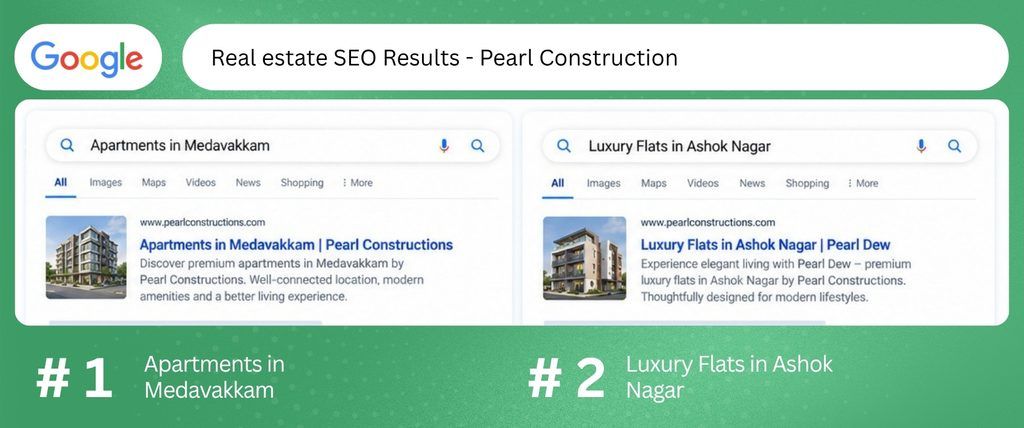
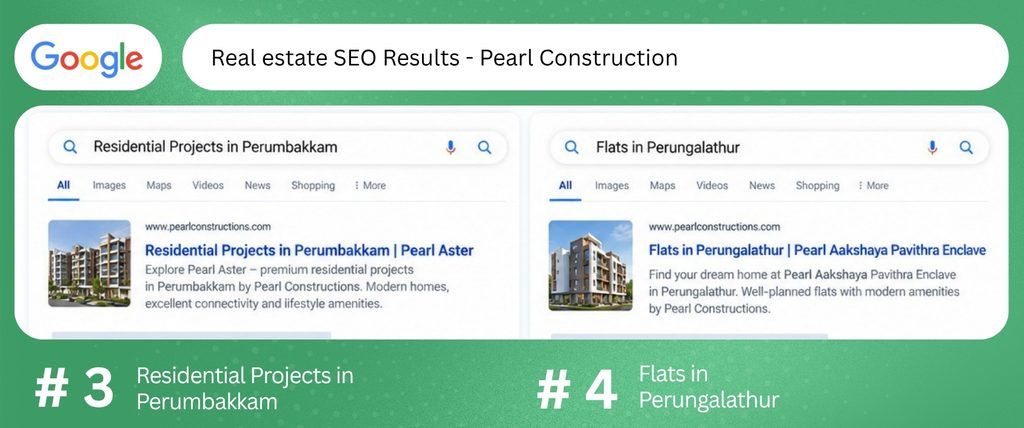
Our real estate SEO strategies are built around measurable search visibility and buyer-intent keywords. For Pearl Constructions, we have successfully improved organic visibility across multiple location-based property searches in Chennai.
The campaign focused on identifying high-intent searches used by prospective homebuyers and optimizing relevant property and location pages to improve their visibility in Google SERPs.
Some of the targeted keywords where Pearl Constructions has achieved visibility include:
- Apartments in Medavakkam
- Luxury Flats in Ashok Nagar
- Residential Projects in Perumbakkam
- Flats in Perungalathur
These keywords represent different property-buying intents and locations. By targeting specific combinations of property type + location + buyer intent, the SEO strategy helps connect Pearl Constructions with users actively researching apartments and residential properties in these areas.
For example, someone searching for “Apartments in Medavakkam” may already be evaluating residential options in that locality, while searches such as “Residential Projects in Perumbakkam” can indicate users comparing new developments and builders.
This demonstrates why real estate SEO should go beyond broad keywords such as real estate company or builders in Chennai. A well-planned strategy can build visibility across multiple local, property-specific and commercial-intent searches, creating more opportunities to bring relevant buyers to project pages.
What This Means for Builders ?
Pearl Constructions is an example of how a focused real estate SEO campaign can target multiple locations and buyer journeys simultaneously.
Rather than relying on a single keyword, our approach combines:
Location Keywords → Property Keywords → Buyer Intent → Optimized Landing Pages → Organic Visibility → Property Enquiries
For builders and real estate developers, this approach can create a wider organic search footprint across the locations and property categories they serve.
Want your property projects to reach more buyers through Google search? Dezvolta can develop a customized real estate SEO strategy around your projects, locations, configurations and buyer-intent keywords.
Real Estate SEO Checklist for Builders
Before launching or reviewing your SEO campaign, check whether your website has:
- ✅ Dedicated pages for every major project
- ✅ Location-specific landing pages
- ✅ High-intent property keywords
- ✅ Optimized project titles and descriptions
- ✅ Strong technical SEO
- ✅ Mobile-friendly pages
- ✅ Fast-loading images
- ✅ Internal linking
- ✅ Local SEO optimization
- ✅ Optimized Google Business Profile
- ✅ Helpful buyer-focused blogs
- ✅ Property/project schema where appropriate
- ✅ Clear enquiry CTAs
- ✅ Conversion tracking
- ✅ Regular Search Console monitoring
- ✅ Quality backlinks and brand mentions
If several of these elements are missing, there’s likely significant room to improve organic visibility and lead generation.
Final Thoughts
For builders, Real Estate SEO Services aren’t simply about ranking a website on Google. The real opportunity is building a search ecosystem around projects, locations, property configurations, buyer questions and high-intent searches.
A strong strategy combines technical SEO, on-page optimization, local SEO, content marketing, authority building and conversion optimization. When these elements work together, a builder creates a sustainable organic channel that brings potential property buyers directly to relevant project pages.
Want more property enquiries from Google? Start by optimizing your website around the searches your buyers actually make.
Dezvolta can help you build a real estate SEO strategy focused on visibility, qualified property leads and measurable conversions.
Frequently Asked Questions
Real Estate SEO Services involve optimizing a builder’s website, project pages, content, technical infrastructure and local presence to increase visibility for relevant property searches and generate qualified organic enquiries.
Yes. SEO can help builders attract users actively searching for apartments, villas, plots, commercial properties, projects and property-related information. Effectiveness depends on competition, website quality, search intent, content and conversion optimization.
A combination of location, property type, configuration, project, brand and buyer-intent keywords — for example, “2 BHK flats in Chennai,” “apartments in Medavakkam,” and “new residential projects in Ashok Nagar.”
Yes. Property searches are highly location-dependent, making local SEO, Google Business Profile optimization, local citations and location-focused content essential components of a real estate SEO strategy.
SEO is generally a long-term strategy. Timeframes vary based on website authority, competition, technical condition, content quality, target locations and keyword difficulty. Progress should be evaluated through rankings, organic traffic, enquiries and conversion data — not expected as an instant result.
Yes, when each project has distinct information and genuine search demand. Dedicated project pages let builders target specific combinations of project, location, configuration and property type.
Yes. Well-researched, buyer-focused content captures informational and long-tail searches, builds topical relevance, and internally links users toward relevant project pages.
By publishing clear, specific, genuinely useful content that directly answers buyer questions, structuring information logically, strengthening technical SEO, and keeping information consistent across the website and other authoritative online properties.
SEO can create an additional direct organic acquisition channel for builders. It should generally complement — not fully replace — other marketing and property-discovery channels.
Organic qualified traffic, project-page visibility, keyword rankings, enquiries, phone calls, form submissions, WhatsApp leads, site-visit requests and ultimately sales-qualified opportunities.