
Published: April 29, 2026
A restaurant can serve great food and still struggle to become memorable.
Customers have hundreds of options when deciding where to eat, order from, celebrate, meet friends or try something new. In that environment, your food is only one part of the decision. Your name, visual identity, menu, packaging, ambience, online presence, communication and overall experience all influence whether customers notice your restaurant, choose it and remember it later.
That is why restaurant branding services go far beyond designing a logo.
Restaurant branding brings strategy, creativity and customer experience together to create a recognizable identity for your restaurant. It helps answer an important question:
Why should customers remember your restaurant instead of choosing another one?
As a branding company in Chennai, Dezvolta helps restaurants, cafés, QSRs, cloud kitchens, bakeries, dessert brands and growing food businesses build distinctive brands that work consistently across physical and digital customer touchpoints.
What Are Restaurant Branding Services?
Restaurant branding services are the strategic and creative services used to establish how a restaurant looks, communicates, feels and is perceived by its customers.
A complete restaurant brand can include:
- Brand strategy and positioning
- Restaurant naming
- Logo and visual identity
- Brand colours and typography
- Brand voice and messaging
- Menu design
- Food packaging design
- Restaurant signage
- Interior and environmental branding
- Food photography direction
- Social media branding
- Website and digital branding
- Delivery-platform branding
- Brand guidelines
- Rebranding and brand refresh
The important distinction is that these elements should not be created independently.
Your Instagram should feel like your restaurant.
Your menu should feel like your packaging.
Your packaging should feel like your storefront.
Your website should feel like the experience customers receive when they walk through the door.
The goal is one recognizable restaurant brand across every customer interactionractive individually. It is to make every touchpoint feel like the same restaurant brand.
Why Restaurant Branding Matters ?
The restaurant industry is highly competitive. A customer can compare restaurants within seconds through Google, Instagram, food delivery platforms and online reviews.
A strong brand gives your restaurant something beyond the food itself: recognition and differentiation.
1. Make Your Restaurant Easier to Remember
A distinctive name, visual identity, colour system, packaging and communication style can make your restaurant easier to recognise when customers encounter it again.
Brand recall matters because customers do not always make immediate purchase decisions.
They may see your restaurant today and return next weekend.
2. Differentiate From Nearby Competitors
If five restaurants offer similar cuisine at similar prices, simply saying that your food is “authentic” or “high quality” is unlikely to create a meaningful difference.
Brand strategy helps identify what your restaurant can own in the customer’s mind.
It could be:
- Premium dining
- Traditional heritage cuisine
- Modern regional food
- Affordable family dining
- A youthful café experience
- Health-focused food
- Fast and convenient meals
- A delivery-first food concept
The branding should make that positioning visible.
3. Support Premium Perception
Customers often associate presentation with perceived value.
A carefully designed menu, premium packaging, consistent photography and polished digital presence can communicate a very different perception from generic visual materials.
Branding does not automatically justify higher prices, but it can help customers understand the experience and value behind your pricing.
4. Encourage Repeat Visits
Discounts can bring customers back temporarily.
A memorable brand can create familiarity and emotional preference.
When customers remember the restaurant, its personality and their previous experience, you have a stronger foundation for repeat business.
5. Prepare the Restaurant for Growth
Branding becomes even more important when a restaurant moves from one location to multiple outlets.
Without clear guidelines, every new outlet may start interpreting the brand differently.
A structured identity system gives your team and vendors a reference for maintaining consistency across locations.
What Do Restaurant Branding Services Include?
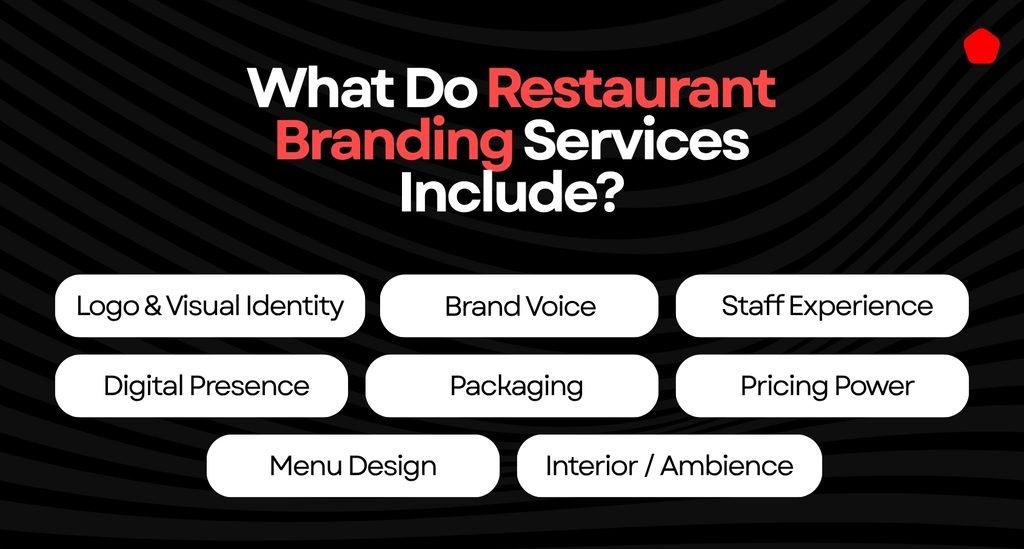
A strong restaurant brand is not built through isolated design decisions. It is built through a system where every element reinforces the same perception. Here is what that system looks like:
| Element | What Most Restaurants Do | What Strong Branding Delivers |
|---|---|---|
| Logo & Visual Identity | Generic logo without a wider system | Distinctive identity with consistent colours, typography and visual elements |
| Menu Design | Basic list of dishes and prices | Structured menu that supports the brand and customer decision-making |
| Packaging | Plain boxes and bags | Branded packaging that builds recognition beyond the restaurant |
| Brand Voice | Random communication and captions | Clear personality across every customer interaction |
| Digital Presence | Inconsistent website and social media | Unified identity across website, Google, social and delivery platforms |
| Interior / Ambience | Functional environment | Experience aligned with the restaurant’s positioning |
| Staff Experience | Service treated only as operations | Staff experience that reinforces brand values |
| Brand Scalability | Different execution across outlets | Consistent system that can grow with the business |
Restaurant Brand Strategy and Positioning
Before choosing colours or designing a logo, you need to understand the business.
Brand strategy can define:
- Target audience
- Market position
- Competitor landscape
- Brand personality
- Unique selling proposition
- Brand promise
- Cuisine positioning
- Pricing perception
- Customer experience
- Long-term business direction
A premium restaurant should not be positioned like a casual QSR.
A traditional South Indian restaurant should not communicate exactly like a modern speciality café.
Strategy determines the direction.
Restaurant Naming and Tagline
Your restaurant’s name is often the first piece of branding customers encounter.
A strong name should ideally be:
- Memorable
- Relevant
- Distinctive
- Easy to pronounce
- Appropriate for the target audience
- Suitable for digital platforms
- Flexible enough for future growth
A tagline can then reinforce the central brand idea.
Logo and Visual Identity
The logo becomes the visual signature of the restaurant.
But professional identity development should also establish:
- Primary logo
- Secondary logo
- Brand mark
- Colour palette
- Typography
- Icons
- Patterns
- Graphic elements
- Photography direction
- Illustration style
The identity needs to work at multiple sizes and across multiple applications.
A logo that looks good on a presentation slide but fails on a food box or storefront is not a complete solution.
Menu Branding and Design
The menu is one of the most important brand touchpoints inside a restaurant.
It needs to balance branding with usability.
Good menu design should consider:
- Visual hierarchy
- Typography
- Dish descriptions
- Food photography
- Category organisation
- Pricing presentation
- Signature dishes
- Brand personality
- Dine-in and digital formats
A premium restaurant may need a sophisticated menu experience, while a QSR requires faster navigation and clearer product communication.
Restaurant Packaging Design
For takeaway and delivery businesses, packaging is part of the product experience.
Customers may interact with your packaging longer than they interact with your storefront.
Branding can be applied to:
- Food boxes
- Delivery bags
- Cups
- Wrappers
- Stickers
- Containers
- Labels
- Thank-you cards
- Promotional inserts
Well-designed packaging can also create additional opportunities for social sharing and brand visibility.
Restaurant Signage and Environmental Branding
Your branding should be visible before customers enter.
This can include:
- Storefront signage
- Reception areas
- Wall graphics
- Wayfinding
- Menu boards
- Table branding
- Promotional displays
- Interior graphic elements
- Staff uniforms
The physical environment should reinforce the positioning established by the brand strategy.
Brand Voice and Restaurant Messaging
A restaurant brand also has a personality in words.
The same restaurant should sound consistent across:
- Website content
- Menu descriptions
- Instagram captions
- Advertisements
- Packaging messages
- Promotional campaigns
- Email communication
- Review responses
A luxury restaurant might communicate with sophistication.
A youthful dessert brand might be playful.
A heritage restaurant may emphasise tradition and authenticity.
The voice should match the actual brand experience.
Digital Restaurant Branding Is Now Essential
Restaurant branding does not stop at the physical location.
For many customers, the first interaction happens online.
They may discover a restaurant through:
- Google Search
- Google Business Profile
- YouTube
- Food delivery platforms
- Restaurant websites
- Online reviews
- Social recommendations
That means your digital presence needs to carry the same identity as the physical restaurant.
Your logo, colours, food photography, tone of voice and messaging should remain recognizable across platforms.
1.Google Business Profile
Your Google Business Profile is more than a local listing.
It is often one of the first places a potential customer checks before deciding whether to visit.
Brand consistency across your restaurant name, description, photographs, posts and customer communication contributes to the overall digital experience.
2.Social Media Branding
Restaurants are naturally visual businesses.
Your food photography, reels, stories, promotional creatives and captions should follow a consistent visual direction.
Instead of every social post looking different, a defined brand system can make your content recognizable even before customers read the restaurant name.
3.Food Delivery Platforms
For cloud kitchens, QSRs and takeaway-focused restaurants, delivery platforms are particularly important.
Your restaurant identity needs to remain recognizable through:
- Restaurant profile images
- Food photography
- Menu presentation
- Product naming
- Packaging
- Promotional assets
This is where strong restaurant branding can connect physical and digital experiences.
Restaurant Branding Services We Offer
At Dezvolta, we approach restaurant branding as a connected business and creative process rather than a collection of isolated design deliverables.
Restaurant Brand Strategy
We help define:
- Brand positioning
- Target audience
- Competitor differentiation
- Brand personality
- Brand promise
- Market opportunity
- Brand messaging
Restaurant Logo & Visual Identity
We develop a visual identity system that can include:
- Logo design
- Colour palette
- Typography
- Graphic elements
- Iconography
- Photography direction
- Visual guidelines
Restaurant Menu Design
We create menu experiences that align with the brand identity across:
- Dine-in menus
- Takeaway menus
- Digital menus
- Promotional menus
- Seasonal menus
Restaurant Packaging Design
We extend your restaurant brand across:
- Food boxes
- Delivery packaging
- Takeaway bags
- Cups
- Wrappers
- Stickers
- Product labels
Restaurant Signage & Environmental Branding
We create consistent branding for:
- Storefront signage
- Interior signage
- Wall graphics
- Wayfinding
- Promotional displays
- Brand installations
Restaurant Digital Branding
We help maintain brand consistency across:
- Restaurant websites
- Google Business Profile
- Social media creatives
- Delivery platforms
- Digital campaigns
Restaurant Brand Guidelines
We document the brand system so your team, designers, printers and future outlets can apply the identity consistently.
A brand guideline can cover:
- Logo usage
- Colours
- Typography
- Photography
- Brand voice
- Graphic elements
- Applications
- Dos and don’ts
Restaurant Branding for Different Food Businesses
Not every restaurant needs the same branding strategy.
Fine Dining Restaurants
Premium restaurants require branding that communicates sophistication, exclusivity and attention to detail.
The identity should extend across menus, interiors, uniforms, signage, photography and digital communication.
Cafés and Coffee Shops
Café branding often depends heavily on atmosphere, visual appeal and community.
Packaging, takeaway cups, interiors, social media and photography can become important parts of the brand experience.
QSR Brands
QSR branding needs to be instantly recognisable and easy to reproduce.
Bold colours, strong visual systems, packaging and scalable brand guidelines are particularly important when multiple outlets are involved.
Cloud Kitchens
Cloud kitchens have limited physical customer interaction, making digital branding and packaging especially important.
The brand must communicate clearly through delivery platforms, social media, food photography, packaging and online ordering.
Bakeries and Dessert Brands
For bakeries and dessert businesses, visual presentation can become a major brand differentiator.
Packaging, product photography, labels, boxes, social media and store displays should work together.
Multi-Location Restaurant Brands
As restaurants expand, consistency becomes increasingly difficult without documented brand standards.
Brand guidelines can help maintain consistency across different outlets, designers, printers and marketing teams.
How to Build a Restaurant Brand Step by Step ?
A professional branding process should begin with strategy rather than immediately jumping into logo concepts.
Step 1: Understand the Business
We begin by understanding the restaurant concept, cuisine, target audience, pricing, location, competition and growth plans.
Step 2: Define the Positioning
We identify what the restaurant should be known for and how it can occupy a distinctive position in the market.
Step 3: Develop the Brand Personality
We define how the restaurant should look, sound and feel.
The personality could be:
- Premium
- Traditional
- Modern
- Bold
- Playful
- Minimal
- Authentic
- Family-oriented
Step 4: Create the Visual Identity
The positioning is translated into the logo, colours, typography, graphic elements and visual direction.
Step 5: Apply the Identity
The identity is extended to menus, packaging, signage, social media, website and other relevant touchpoints.
Step 6: Create Brand Guidelines
Brand guidelines document how the identity should be used.
This helps maintain consistency as the restaurant grows.
Step 7: Launch and Refine
Branding should continue beyond the initial launch.
Customer feedback, business growth and new products may require refinements while maintaining the core identity.stently by your internal team, vendors, designers and future outlets.
Restaurant Branding Examples That Work
The most useful way to understand restaurant branding is to examine how successful brands create a consistent experience.
McDonald’s: Consistency as Brand Strategy
McDonald’s demonstrates how consistency can become a powerful brand asset. Its recognisable visual identity, store experience, packaging and communication work together across markets.
The lesson: A recognisable and consistently applied identity can create familiarity and trust at scale.
Nando’s: Personality as Competitive Advantage
Nando’s demonstrates how a distinctive personality can become part of the customer experience. Its communication style extends beyond advertising into menus, packaging, social media and in-store interactions.
The lesson: A distinctive brand personality can help a restaurant stand apart in a crowded market.
Starbucks: Experience as the Product
Starbucks demonstrates how a restaurant or café brand can sell more than the core product. Store environment, packaging, visual identity, customer experience and communication all contribute to a consistent brand perception.
The lesson: Customers often buy the experience and meaning associated with a brand, not simply the product itself.
Dezvolta‘s Restaurant Branding Case Study: Biriyani Mubaarak
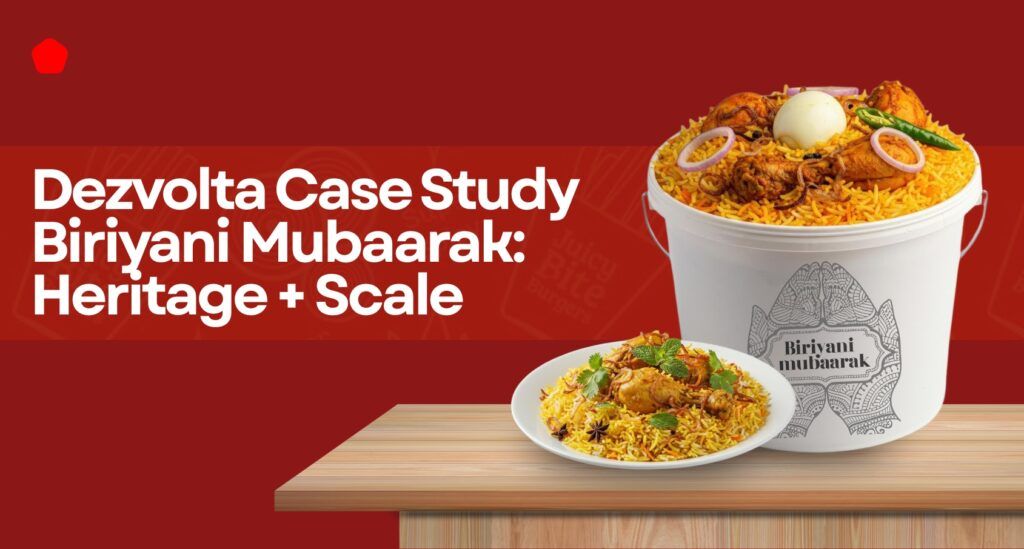
Biriyani Mubaarak: Heritage + Scale
Biriyani Mubaarak is a Chennai-based brand rooted in Tamil Muslim Kalyana biryani culture.
The challenge was to create a brand that felt authentic to its heritage while also being structured for modern formats, takeaway, dine-in and future expansion.
The Branding Approach
Dezvolta focused on building the brand around heritage, celebration and authenticity while creating a visual system that could be consistently applied across customer touchpoints.
The branding approach included:
- Brand positioning
- Visual identity
- Colour system
- Typography
- Icon system
- Packaging design
- Brand applications
The result was a more distinctive restaurant identity designed to stand apart from generic biryani branding while providing a foundation for future growth.
The lesson: Authenticity becomes a competitive advantage when it is expressed through a clear and consistent brand system.
Why Most Restaurant Branding Fails ?
Most restaurant brands do not struggle because the logo is necessarily bad. They struggle because the brand lacks strategic direction, consistency or differentiation.
Common problems include:
- Copying competitors instead of developing a distinctive identity
- Treating branding as decoration rather than strategy
- Using different visual styles across touchpoints
- Ignoring digital brand presence
- Having inconsistent packaging and menu design
- Expanding without brand guidelines
- Communicating without a defined brand voice
- Rebranding when a focused brand refresh would have been sufficient
A strong restaurant brand requires both creative quality and strategic consistency.
DIY vs. Hiring a Restaurant Branding Agency
This is a genuine decision with real trade-offs on both sides. Here is an honest comparison:
| DIY Branding | Working with a Branding Agency | |
|---|---|---|
| Cost | Lower upfront cost | Higher upfront; lower long-term rework cost |
| Time | Months to learn & execute | Faster turnaround with specialists |
| Consistency | Hard to maintain without guidelines | Structured system built for consistency |
| Scalability | Breaks as you grow | Designed to scale across outlets and formats |
| Results | Generic, unrefined brand | Distinctive brand that commands premium pricing |
| Best For | Solo pop-ups or test concepts | Restaurants serious about growth and positioning |
The right choice depends on your stage and your ambition. If you are testing a concept on a very limited budget, thoughtful DIY branding — with tools like Canva, a careful colour palette, and consistent photography — can get you started. But if you are serious about scaling, or if you are investing significantly in a launch, professional branding is one of the highest-return investments you can make.
Restaurant Branding Services in Chennai: What’s Different
Chennai’s restaurant market includes everything from traditional restaurants and premium dining concepts to cafés, QSRs, cloud kitchens and multi-location food brands.
For a restaurant branding strategy to work, the brand needs to consider its specific audience, location, competition and customer behaviour.
A restaurant in Anna Nagar may have different positioning opportunities from one in OMR, T. Nagar, Velachery or another part of Chennai.
Our restaurant branding services in Chennai can help businesses build a brand around:
- Local customer expectations
- Cuisine and cultural identity
- Target audience
- Competitive positioning
- Digital discovery
- Packaging
- Physical customer experience
- Future expansion
We combine brand strategy and creative execution to help Chennai restaurants build identities that are distinctive, consistent and scalable.
| Factor | Generic Approach | What Works in Chennai |
|---|---|---|
| Audience | Treat Chennai as one market | Adapt per micro-location: Anna Nagar, OMR, T. Nagar, Velachery |
| Language | English-only messaging | Tanglish blend in brand voice; Tamil in signage where appropriate |
| Discovery | Depend on footfall or ads | Instagram-led discovery; Google Maps presence optimised |
| Visual Identity | Basic interiors | Bold identity with deliberate ambience design |
| Packaging | Functional plain packaging | Branded packaging with shareability built in |
| Retention | Discount-driven loyalty | An emotional connection that outlasts offers |
How Much Do Restaurant Branding Services Cost?
The cost of restaurant branding depends on the scope, complexity and number of brand touchpoints involved.
A basic identity project may focus on logo and visual identity, while a complete restaurant branding project may include strategy, naming, visual identity, menu design, packaging, signage, digital branding and brand guidelines.
Factors that can influence the investment include:
- Brand strategy requirements
- Logo and visual identity
- Number of design deliverables
- Menu requirements
- Packaging requirements
- Signage and environmental branding
- Digital branding
- Number of outlets
- Rebranding vs new brand development
- Franchise or multi-location requirements
Rather than offering the same package to every restaurant, we recommend defining the branding scope around your business stage, objectives and growth plans.
Talk to Dezvolta for a customised restaurant branding proposal.
Modern Restaurant Branding: The Digital and AI Layer
Restaurant branding no longer exists only inside the physical restaurant.
Customers increasingly discover and evaluate restaurants through digital platforms before visiting.
Instagram as a Discovery Channel
Instagram can act as a visual discovery engine for restaurants.
Food presentation, interiors, packaging, typography and photography should create a recognisable visual identity that customers can associate with the brand.
Google as a Trust Layer
Customers often check:
- Reviews
- Ratings
- Photos
- Location
- Opening hours
- Restaurant information
A complete and consistent Google Business Profile therefore becomes part of your restaurant’s digital brand experience.
AI Search and Discovery
AI-powered search and recommendation experiences are changing how people discover businesses.
A restaurant should maintain clear and consistent information across its website, business profiles and other digital platforms. Strong brand positioning, clear descriptions, structured information, customer reviews and consistent business details can help create a more understandable digital presence.
Omnichannel Brand Consistency
Your:
- Website
- Google Business Profile
- Delivery platforms
- Packaging
- Menu
- Physical restaurant
should all feel like the same brand.
A customer should not see one identity on Instagram and a completely different experience when they arrive at the restaurant.
How Dezvolta Builds Restaurant Brands ?
At Dezvolta, we approach restaurant branding as a business growth system rather than a one-time logo design project.
Positioning Before Design
Every strong brand begins with strategic clarity.
We consider your market, audience, competitors, differentiation and long-term goals before developing the visual identity.
System, Not Just Aesthetics
We create connected brand systems that can include:
- Colours
- Typography
- Logo variations
- Graphic elements
- Brand voice
- Photography direction
- Usage guidelines
This helps your brand remain consistent across different applications.
Execution Across Every Touchpoint
The brand should not stop at the logo.
We help extend the identity across menus, packaging, signage, digital platforms and other customer touchpoints so the entire experience feels connected.
Built for Growth
For restaurants planning multiple outlets or franchise expansion, the brand system should be easy to reproduce.
We build brand guidelines and scalable visual systems that can help maintain consistency as the restaurant grows into new locations.
Restaurant Branding Checklist
Use this checklist to evaluate whether your restaurant has a complete and consistent brand system.
Strategy & Positioning
- Clear brand positioning
- Defined target customer
- Clear differentiation
- Competitor analysis
- Brand personality
- Brand promise
Visual Identity
- Primary logo
- Secondary logo or icon
- Colour palette
- Typography system
- Photography direction
- Supporting graphic elements
- Brand guidelines
Physical Touchpoints
- Menu design
- Packaging
- Signage
- Takeaway materials
- Staff presentation
- Interior brand elements
Digital Presence
- Branded website
- Complete Google Business Profile
- Consistent Instagram identity
- Branded delivery platform presence
- Consistent photography
- Brand-aligned review responses
Scalability
- Brand guidelines documented
- Reusable templates
- Consistent supplier application
- System suitable for additional outlets
- Franchise-ready brand standards where required
Why Choose Dezvolta for Restaurant Branding?
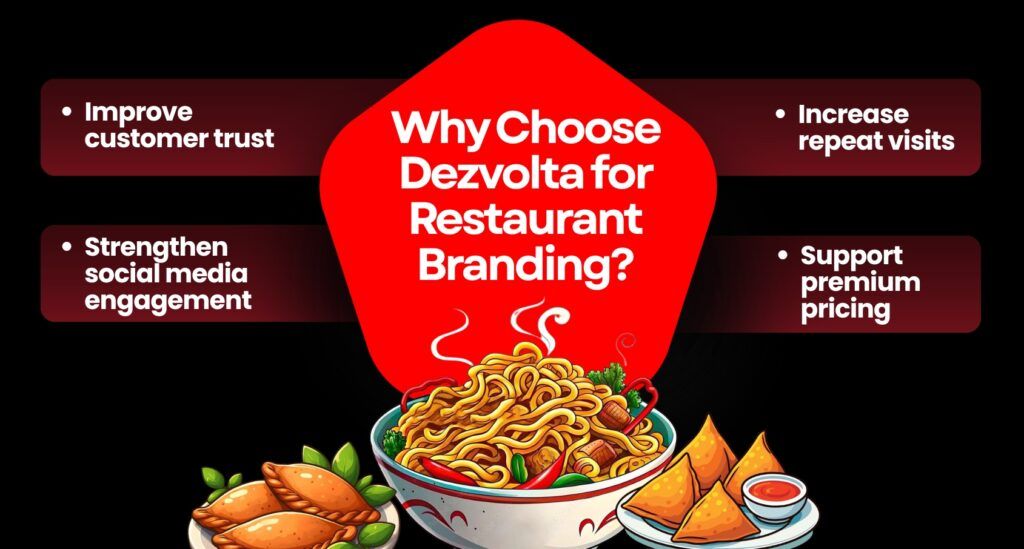
At Dezvolta, we combine brand strategy, creative design, digital expertise and business thinking to help restaurants build brands that are more than visually attractive.
Our approach focuses on:
Strategy Before Aesthetics
We start with the business, customer and market before moving into creative execution.
Full-Service Brand Development
From positioning and identity to packaging, menus, digital branding and guidelines, we can connect multiple branding requirements through one strategic direction.
Built for Restaurant Businesses
We understand that restaurant brands have multiple customer touchpoints, including physical spaces, menus, packaging, online discovery, reviews and social media.
Designed for Growth
Our branding systems are structured to support restaurants as they add products, outlets, locations or new business formats.
Business-Focused Branding
The goal is not simply to create a beautiful brand. It is to create an identity that supports recognition, trust, differentiation and long-term business growth.ding strategies that combine creativity, business psychology, customer behaviour analysis, and digital growth.
Ready to Build a Restaurant Brand That Lasts?
Your restaurant deserves more than a logo.
It needs a clear position, memorable identity and consistent experience that customers can recognise across every touchpoint.
Whether you are:
- Launching a new restaurant
- Rebranding an existing restaurant
- Building a café or QSR
- Growing a cloud kitchen
- Developing a food brand
- Opening multiple outlets
- Preparing for franchise expansion
Dezvolta Branding Ageny can help you build the branding system behind your next stage of growth.
Talk to Dezvolta about your restaurant branding project and get a customised strategy for your brand.
Frequently Asked Questions
Restaurant branding services cover the strategy, design and implementation required to build a consistent restaurant brand. Depending on the project, this can include brand positioning, logo design, visual identity, menu design, packaging, signage, digital branding, brand messaging and brand guidelines.
A restaurant branding agency helps define how a restaurant should be positioned, presented and experienced by its target customers. This can involve research, brand strategy, visual identity, packaging, menus, digital branding, signage and customer experience.
Restaurant branding can include brand strategy, positioning, naming, logo and visual identity, menu design, packaging design, signage, brand voice, digital branding and brand guidelines. The exact scope depends on the restaurant’s requirements.
Restaurant branding costs vary based on the scope of work. A project focused only on visual identity will require a different investment from a complete branding project covering strategy, identity, menus, packaging, signage, digital branding and guidelines.
The timeline depends on the scope and number of deliverables. A complete restaurant branding project involving research, strategy, visual identity and multiple brand applications generally requires several weeks from discovery through final guidelines and implementation.
Yes. Smaller restaurants can build strong brands through clear positioning, distinctive personality, authentic storytelling and consistent execution. A focused niche and memorable customer experience can help smaller brands stand out without attempting to imitate larger chains.
Consider rebranding when your existing identity no longer represents your business, your target audience has changed, your brand looks inconsistent across touchpoints, you are repositioning the business or you are preparing for significant expansion.
Branding defines what your restaurant represents, how it is positioned and how customers should perceive it. Marketing communicates that brand to potential customers. Branding establishes the identity; marketing helps distribute and promote it.
They can. Menu design and packaging design are important brand touchpoints, particularly for restaurants, cafés, QSRs, takeaway businesses and cloud kitchens. They can be developed as part of a broader restaurant branding project.
Yes. Dezvolta provides restaurant branding services in Chennai for restaurants, cafés, QSRs, cloud kitchens, bakeries, food brands and growing restaurant businesses.
Yes. Restaurant rebranding can involve repositioning the brand, refreshing or rebuilding the visual identity, redesigning menus and packaging, updating digital assets and creating brand guidelines for consistent implementation.
Yes. Cloud kitchens and QSRs often require highly recognisable digital, packaging and visual identities. Branding can be structured around delivery platforms, packaging, social media, menus and scalable applications across multiple locations.
Look for an agency that can demonstrate relevant branding work, understands the restaurant and F&B market, starts with strategy rather than only design, provides a clear process and can create a complete brand system that remains consistent as your restaurant grows.
Table of Contents
✕- What Do Restaurant Branding Services Include?
- How to Build a Restaurant Brand Step by Step ?
- Dezvolta‘s Restaurant Branding Case Study: Biriyani Mubaarak
- Why Most Restaurant Branding Fails ?
- DIY vs. Hiring a Restaurant Branding Agency
- Restaurant Branding Services in Chennai: What’s Different
- Modern Restaurant Branding: The Digital and AI Layer
- How Dezvolta Builds Restaurant Brands ?
- Restaurant Branding Checklist
- Why Choose Dezvolta for Restaurant Branding?
- Frequently Asked Questions