
Published: April 22, 2026
If you’re a manufacturer and your website isn’t generating enquiries, it’s almost certainly not a product problem — it’s a visibility problem.
Procurement teams and engineers don’t wait for trade shows or cold calls anymore. They go to Google and search for suppliers before they contact anyone. If your business doesn’t appear for the searches that matter, you’re not losing to better manufacturers, you’re losing to better-ranked ones.
This guide covers exactly how SEO for manufacturers works, what makes it different from generic SEO, and how to use it to generate consistent B2B leads from Google.
What Is SEO for Manufacturers?
SEO for manufacturers is the process of making your website appear on Google when buyers — procurement managers, engineers, sourcing heads — search for the products or capabilities you offer.
It’s not about chasing high traffic numbers. It’s about showing up for the specific, technical, intent-driven searches that indicate someone is ready to shortlist suppliers or send an RFQ.
For example:
- “ring gasket manufacturer India” — buyer intent
- “CNC machined aluminium parts supplier” — buyer intent
- “ISO certified flanged gasket” — buyer intent
- “what is a gasket?” — researcher, not a buyer
The difference matters. Generic SEO brings you the second type. Manufacturing SEO is built to attract the first.
Why SEO is Now Critical for Manufacturing Business ?
The way B2B purchasing works has fundamentally shifted. A 2024 Forrester study found that over 70% of B2B buyers complete most of their research online before engaging a supplier. In manufacturing, that number is rising fast — especially for export-driven businesses where cold outreach is expensive and trade shows are infrequent.
What this means practically:
- Buyers are forming their shortlists on Google before they call anyone
- If you’re not on page one, you’re not on their list
- Your competitors who rank are getting the RFQs you should be getting
SEO turns this dynamic in your favour. Instead of chasing buyers, you become the business they find when they’re already looking.
What Makes Industrial SEO Different ?
SEO for Manufacturers Is Not the Same as SEO for Other Businesses
Manufacturing buyers search differently. They use technical language specific materials, tolerances, certifications and application types. They research for weeks before contacting a vendor. And they have high purchase values, meaning even one extra client per quarter is worth tens of thousands in revenue.
This is where most manufacturers get burned by generic agencies.
Standard SEO chases search volume. Manufacturing SEO chases search intent. These are very different things.
Generic approach: Target “industrial gaskets” (10,000 searches/month, mostly researchers) Manufacturing SEO approach: Target “metal jacketed gasket supplier Chennai” (50 searches/month, almost all buyers)
The second keyword sends you one enquiry per month that converts into a ₹15 lakh order. The first sends you 300 visitors who read your article and leave.
In manufacturing, the right 50 visitors beat the wrong 10,000 every time.
What manufacturing-specific SEO focuses on:
- Product and component-specific queries (exact names, part numbers, material grades)
- Application-based searches (what the product is used for)
- Geography + product combinations (“valve manufacturer Gujarat”)
- Certification and compliance searches (“ASME certified pressure vessel manufacturer”)
- Industry-vertical searches (“gasket supplier for oil and gas”)
The 5 Pillars of a Manufacturing SEO Strategy
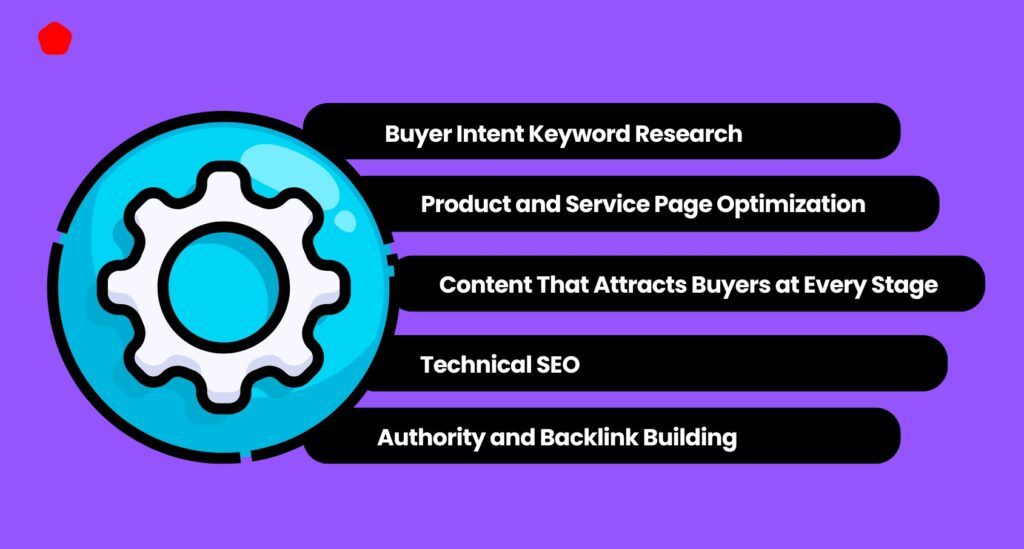
1. Buyer Intent Keyword Research
Start by mapping how your actual buyers search, not how you describe your own products internally.
Talk to your sales team. Look at your enquiry emails. What exact words do buyers use when they contact you? Those are your keywords.
Then expand around:
- Materials
- Applications
- Standards
- Geographies (your target markets)
Tools like Google Search Console will show you what queries are already bringing people to your site and whether those people are buyers or researchers.
2. Product and Service Page Optimization
Your product pages are your most important SEO and conversion assets. Most manufacturing websites treat them like a catalogue entry. They need to work like a sales page.
A well-optimized product page includes:
- A clear, keyword-rich title and headline
- Full technical specifications (dimensions, materials, tolerances, standards)
- Application context — what industries use this, what problems it solves
- A clear next step (enquiry form, WhatsApp button, phone number)
- Internal links to related products and your contact page
Thin product pages with two lines of description will not rank and even if they do, they won’t convert.
3. Technical SEO
Even the best content won’t rank if Google can’t properly crawl and index your website.
Common technical issues on manufacturing websites:
- Slow page load speed (especially on mobile)
- Poor mobile experience
- Duplicate or near-duplicate product pages
- Missing or broken internal links
- No schema markup on product pages
- Indexing issues with large catalogs
A technical SEO audit identifies exactly which of these are holding your site back.
4. Content That Attracts Buyers at Every Stage
Not every buyer is ready to enquire immediately. Some are in early research mode — comparing options, learning about standards, understanding what they need.
Content that serves this stage includes:
- Comparison guides (“Ring Gasket vs Spiral Wound Gasket — Which Is Right for Your Application?”)
- Technical explainers (“Understanding ASME B16.20 Gasket Standards”)
- Industry-specific use cases (“Sealing Solutions for the Oil & Gas Industry”)
- Buyer guides (“How to Select the Right Industrial Gasket Supplier”)
This content ranks for research-stage queries, builds your authority, and introduces your brand before buyers are ready to enquire. When they are ready, you’re already the most familiar name.
5. Authority and Backlink Building
Google ranks websites it trusts. In manufacturing, trust comes from being mentioned and linked to by relevant industry sources, trade directories, supplier networks, industry publications and partner websites.
A few strong, relevant backlinks from industrial sources outperform dozens of generic ones. This is not about quantity, it’s about relevance to your sector.
Want this done for your manufacturing website?
Dezvolta specializes in SEO for industrial and B2B manufacturing businesses. We handle everything — keyword strategy, page optimization, technical fixes, and content.
How SEO Works Across Manufacturing Industries
Different manufacturing sectors require different keyword strategies and content approaches. There’s no one-size-fits-all template.
| Industry | How Buyers Search | What Converts Them |
|---|---|---|
| Precision Engineering & CNC | Part name + tolerance + material + “supplier” | Detailed specs, certifications (ISO, AS9100), tolerance data, case studies |
| Industrial Gaskets & Sealing | Product type + material + application + location | Technical datasheets, temperature/pressure ratings, and sample requests |
| Heavy Equipment & Machinery | Application + capacity + “manufacturer” or “supplier” | Use case examples, load specs, maintenance support, inquiry forms |
| Electronics Manufacturing | Component + spec + “OEM manufacturer” | Compliance certifications, production volumes, lead time guarantees |
| FMCG & Mass Manufacturing | “Bulk supplier” + product + “minimum order” | MOQ clarity, distribution reach, pricing structure, quality assurance |
| Sheet Metal & Fabrication | Material + process + “custom fabrication” | Capability statements, past project examples, turnaround times |
What Dezvolta Does Differently for Manufacturing SEO
We’ve worked with industrial businesses in precision engineering, gaskets and sealing, heavy equipment, electronics manufacturing, and B2B supply chains. Here’s what we’ve learned: manufacturing SEO is not about more content or more backlinks. It’s about building a system that maps your capabilities to the exact moments buyers are searching.
| What most agencies do | What Dezvolta does |
|---|---|
| Chase keyword volume | Target buyer-intent queries that lead to RFQs |
| Write generic service pages | Build product and capability pages buyers actually convert on |
| Report on traffic | Report on leads, enquiry quality, and pipeline impact |
| Use a standard SEO template | Build strategy around your sales cycle and buyer type |
| Set and forget | Continuously optimise based on real conversion data |
What’s Included in Our Manufacturing SEO Services ?
1. Industrial Keyword Strategy: We map exactly how your buyers search — by product name, application, material, certification, and geography and build your entire SEO foundation around real buying intent, not volume guesses.
2. Product & Category Page Optimization: Your product pages are your most important conversion assets. We rewrite and restructure them to serve both Google and technically informed buyers with proper specifications, use-case content, and clear next steps.
3. Technical SEO for Manufacturing Websites: Large catalogs, outdated CMS setups and poor site architecture silently kill rankings. We fix crawlability, indexing, page speed and mobile performance so your content actually gets found.
4. Content That Attracts Decision-Makers: From technical guides and comparison pages to application-specific articles, we create material that pulls buyers in during their research phase and keeps Razvolta top of mind.
5. Authority & Backlink Building: We build credibility through relevant industry directories, supplier networks, and sector-specific publications, not random links. A few strong industry signals outperform hundreds of generic ones.
6. Performance Tracking & Continuous Optimization: Monthly reporting tied to what matters: keyword rankings, qualified traffic, enquiry volume, and conversion rates, not vanity metrics.
KPIs That Actually Matter for Manufacturing SEO
We don’t report on vanity metrics. Here’s what we track for manufacturing clients and why each metric matters:
| KPI | Why It Matters | What Good Looks Like |
|---|---|---|
| Enquiry / RFQ volume | Direct measure of business impact | Month-on-month growth in qualified inbound leads |
| Buyer-intent keyword rankings | Shows visibility to actual buyers | Page 1 rankings for product and application queries |
| Organic traffic from target regions | Reveals geographic reach to buyers | Growing share of traffic from target export markets |
| Product page conversion rate | Measures how well pages convert visitors | Increasing ratio of visits to enquiry form submissions |
| Time on product pages | Indicates content relevance to buyers | Buyers spending 2+ minutes on key product pages |
| Enquiry quality | Ensures traffic is genuinely qualified | RFQs with specific product, volume, and spec requirements |
Real Example — How This Works in Practice
Asian Sealing Products, Chennai
Asian Sealing Products manufactures ring gaskets, metal jacketed gaskets and flange insulation gaskets. Strong product range, but when we started working with them, their website was invisible to the searches their buyers were making.
What we did:
- Identified the exact queries buyers use when sourcing industrial gaskets
- Rebuilt product pages with full technical specifications and application context
- Fixed technical issues that were preventing Google from properly indexing the site
- Built relevant backlinks from industrial directories and supplier platforms
The result:
- First-page rankings for multiple high-intent product keywords
- Consistent increase in inbound enquiries from buyers who found them on Google
- Expanded reach into national markets beyond their existing offline network
This is what manufacturing SEO services looks like when it’s executed correctly, not vanity traffic, but buyers who are already looking for what you make.
Key takeaway: This isn’t about gaming search engines. It’s about making sure that when your buyers search for what you make, they find you and your page gives them every reason to make contact.
Common SEO Mistakes Manufacturers Make
1. Targeting keywords that attract researchers, not buyers. “What is a gasket?” gets traffic. “Flange gasket supplier for the petrochemical industry” gets enquiries. Know the difference.
2. Thin product pages. Two lines of description won’t rank and won’t convert. Buyers expect technical depth. Google rewards it.
3. Ignoring mobile, Industrial buyers increasingly search on mobile. A site that’s hard to use on a phone loses them immediately.
4. No content strategy. A static website with only product pages can only rank for a narrow set of keywords. Content expands your reach into research-stage searches and builds authority over time.
5. Chasing rankings without tracking leads. Traffic is not the goal. Enquiries are. Track which pages generate contact form submissions, WhatsApp messages, and calls — not just which pages get visitors.
6. Expecting instant results, SEO compounds over time. The businesses generating consistent inbound enquiries from Google today started 6–12 months ago. The best time to start is now.
How Long Does SEO Take for Manufacturers?
This is the most common question — and the honest answer is: it depends, but here are realistic benchmarks.
| Timeframe | What to Expect |
|---|---|
| Month 1–2 | Technical fixes, page optimization, keyword mapping. Early ranking movement on low-competition terms. |
| Month 3–4 | Stronger rankings appear. Traffic starts growing. First inbound enquiries from organic search. |
| Month 5–6 | Page-one rankings for primary keywords. Consistent enquiry flow begins. |
| Month 6–12 | Authority compounds. Rankings stabilize. Content starts generating traffic from multiple keyword clusters. |
The manufacturers who get the best results are the ones who commit to 6–12 months and treat SEO as a long-term growth channel, not a quick fix.
What Does Manufacturing SEO Cost?
There’s no single answer, but here’s what drives the cost:
- Website size — more product pages means more optimization work
- Competitive landscape — highly competitive niches require more effort to break through
- Content requirements — how much new content needs to be created
- Technical starting point — how many technical issues need fixing first
- Geographic scope — targeting domestic vs international markets changes the scale
The right starting point is a website audit. It tells you exactly what your site needs, what the gaps are, and what a realistic investment looks like for your specific situation.
How to Choose the Right SEO Agency for Your Manufacturing Business

Not every SEO agency understands manufacturing. Here’s what to look for:
- Experience with B2B, technical and industrial businesses (not just ecommerce or local services)
- A process that starts with buyer intent research, not just keyword volume
- Clear reporting tied to enquiries and leads, not just rankings and traffic
- Case studies from manufacturing or industrial clients
- Transparent timelines and realistic expectations (anyone promising page-one rankings in 30 days is not being honest)
The right partner treats your SEO as a business growth system — not a monthly checkbox.
Ready to Get Your Manufacturing Business Found on Google?
Most manufacturers don’t have a product problem. They have a discovery problem. The buyers you want are searching right now. The question is whether they find you or your competitors.
Dezvolta builds manufacturing SEO systems that generate consistent inbound enquiries from Google. If you want to understand exactly what’s holding your site back and what it would take to fix it, start with a free audit.
Frequently Asked Questions
SEO for manufacturers is optimizing your website to appear when engineers, procurement managers, and sourcing teams search for your products or capabilities on Google. It focuses on technical, product-specific, and intent-driven search queries rather than general traffic.
Early ranking improvements typically appear within 60–90 days. Consistent inbound enquiries from organic search usually follow within 3–6 months, depending on your niche’s competitiveness and your website’s starting condition.
Focus on product-specific, application-based, and buyer-intent queries for example, “ISO certified flanged gasket supplier” or “CNC aluminium parts manufacturer India” rather than broad informational terms.
Yes — often better than in broad markets. Niche industrial searches have lower competition, higher buyer intent, and a shorter path to enquiry. A well-targeted strategy for a niche product frequently outperforms generic SEO for common products.
It depends on your website size, competition, and scope. The best starting point is a free audit, which gives you a clear picture of what your site needs and what a realistic investment looks like.
Yes, often more effectively than in broad markets. Niche industrial searches have less competition, higher buyer intent, and a direct path to enquiry. A precisely targeted strategy for a niche product frequently outperforms a generic approach for a common one.
Yes. Dezvolta works with manufacturers targeting domestic Indian buyers and export markets across Europe, the Middle East, North America, and Southeast Asia.