Published: January 2, 2026
Change is the only constant, and the world of digital visibility is undergoing it. Even the search landscape you were used to two years ago is already obsolete. Companies today are torn between the time-honored tenets of SEO and the new trend of GEO, and denying that this trend is occurring is the quickest method to fade out of the web world. In this SEO vs GEO battle, it does not matter which one wins, but how quickly a brand evolves before AI-powered search engines can rewrite the rankings of online discovery.
Conventional SEO can never be ignored, yet search engines are no longer dependent on keywords and backlinks. With AI models providing direct answers, retrieving citations, and extracting structured information, the game has changed. Companies either grow by optimizing generative engines or get buried by AI summaries. It is no longer adaptation, but survival.
What Is SEO?
SEO, Search Engine Optimization is the conventional approach to enhancing a Site’s visibility in search engines by optimizing content, structure, and signals of authority. It focuses on improving your pages’ rankings in search results so users discover them through organic search. It includes optimizing on-page factors, building backlinks, enhancing technical functionality, and ensuring your Site fulfils the search intents people have over competitors.
Traditional SEO is based on foreseeable cues, including keywords, crawlability, mobile-friendliness, page speed, and relevance. These factors help Google’s search engine understand, catalog, and rank your pages. And within the broader scope of geo and seo, conventional SEO continues to be the basis of the discovery of any website. You are not going to compete without concrete SEO, regardless of how sophisticated your generative engine optimization plan may get.
Types of SEO
SEO is not a single strategy but a system of systems that combine to ensure that search engines know, appraise, and trust your site. All these components must be in line to remain visible, not only by keyword stuffing or random backlink hunting.
The main types of SEO include:
- On-Page SEO: Focuses on optimizing content, keywords, headings, and internal links.
- Off-Page SEO: Authority is established through citations, references, and external sources.
- Technical SEO: Makes your site faster, crawlable, secure, and in the proper format.
- Local SEO: Helps your business show up in location-based and map searches.
- Content SEO: Develops user-query-driven content that answers the query.
- Entity SEO: Organizes data in a manner that makes sense to the AI system in the form of a brand, a topic, and a relationship.
All these forms combine to form an entire SEO framework that supports both the old and the future search engine optimization.
What Is GEO?
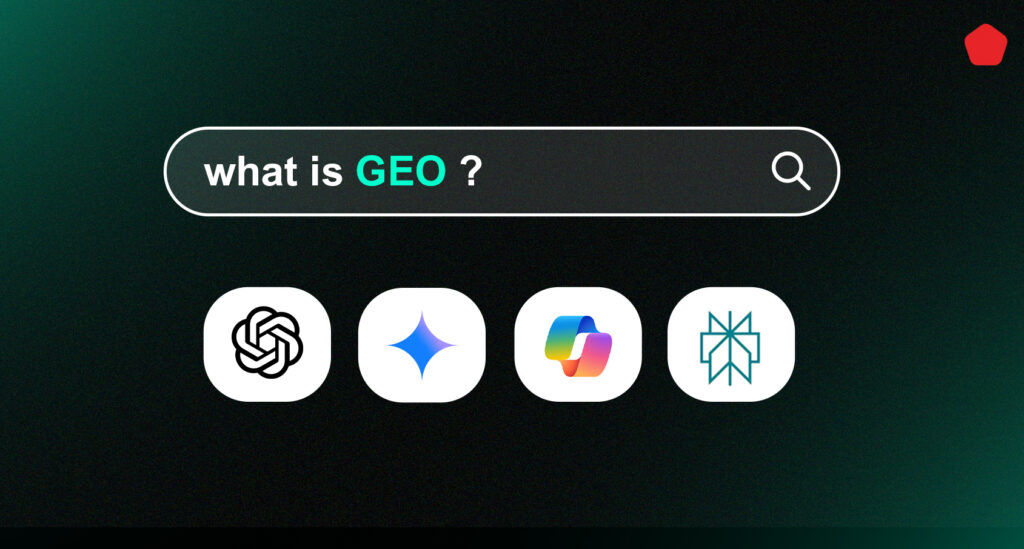
GEO (Generative Engine Optimisation) is the art of ensuring that your content can be extracted and comprehended by the AI search engine and used within its answers. Unlike traditional SEO, which focuses on ranking, GEO aims to be included in AI-generated summaries on platforms such as Google SGE, Perplexity, and ChatGPT Search.
Generative engines are not concerned with keyword density or backlink profiles like traditional algorithms are. They check clarity, structure, the depth of the factual and the precision of the entity. They extract information from various sources, compile a response, and refer to clear, unambiguous, and authoritative material.
GEO is part of a broader dialogue with SEO, not an opposing force. There is no SEO vs. GEO; it is always SEO and GEO. SEO acquaints you with blue links; GEO with surfacing feels like being visible to the user before they click. In practice, GEO would make your content available and reliable in a world where AI systems screen information and then display web pages.
How AI Search Engines Actually Work (Before You Learn GEO)
Before you are going to be trained in generative engine optimization, you must have a crude concept of how AI search engines work, since they are not the same as the old Google search page. Rather than prioritizing websites one at a time, AI tools retrieve information from various sources and generate an answer in real time.
Here’s the simple version:
- Google SGE scans multiple pages and identifies the clearest, most reliable information to create the summary.
- Perplexity favors factual content that is clean and does not cite pages that do not feel trustworthy or well-structured.
- ChatGPT Search seeks out information that is accurate, easy to digest, and well-suited to a direct response.
AI engines do not like fluff or keyword stuffing. They desire simple, well-arranged information that they can carry with ease. Unless your content is clear, structured, and easily decipherable by AI, it just gets disregarded.
How to Do Generative Engine Optimization (GEO)
1. Write down straightforward, extractable answers.
Generative engines erase clean sentences and send them directly into summaries. Avoid soft openings, ornamental language or fillers.
If a sentence cannot be copied to an answer given by AI without editing or reoptimization, this is the only principle between GEO-friendly writings and generic SEO writings.
2. Use Entities with Surgical Clarity.
AI systems do not sort information by keywords; instead, they sort it by entities. Identify the brand, product, tool, place, name, service or event in a definite and explicit manner.
Topicality makes you more likely to appear in the text of AI-generated work in SGE, Perplexity, and ChatGPT Search.
3. Arrange your data in the form of a database.
- AI engines like structured and scannable content. Use:
- Bulleted lists
- Tables
- Short definitions
- Step-by-step frameworks
- Clear Q&A blocks
Such formats assist generative engines in organising and reusing your information in real time.
4. Insert schema and factual indicators.
Structured data provides AI with a machine-readable blueprint of your page.
Use types of schemas, including:
- FAQ
- HowTo
- Product
- Organization
- WebPage
Schema increases your chances of being quoted, of having snippets, and of generating summaries. It is one of the essential conditions for the generative engine optimisation provided by contemporary digital agencies.
5. More Facts, Less Words.
Generative engines have the following:
- Hard facts
- Quantitative data
- Dates and timelines
- Clear definitions
- Verified statements
- Process breakdowns
Superficial or bland content is disregarded, while sound is optimised. GEO is compensating for accuracy and not puffing to the wind.
SEO vs GEO: A Side-by-Side Comparison
Let’s take a quick look at the difference between SEO vs GEO:
| Aspect | SEO (Search Engine Optimization) | GEO (Generative Engine Optimization) |
|---|---|---|
| Primary Goal | Rank higher on Google’s traditional results page | Appear inside AI-generated answers and summaries |
| Focus Area | Keywords, backlinks, technical performance | Entities, clarity, structured facts, topic coverage |
| How It Works | Google ranks pages using algorithmic signals | AI pulls information from multiple sources to build answers |
| Content Style | Long-form, keyword-driven | Clear, direct, fact-based, machine-readable |
| User Visibility | Blue links on SERPs | AI summaries, citations, quick answers |
| Best For | Classic search traffic | AI search visibility across SGE, Perplexity, ChatGPT |
| Effort Type | Ongoing optimization + link building | Clean structuring, accuracy, authority signals |
| Goal in Business Terms | Get clicks from organic search | Get featured in AI responses before the click happens |
What’s the Difference Between Traditional SEO and AI Search Optimization?
Traditional SEO is based on ranking; all you do is push your webpage up the Google ranking list. It is based on keywords, backlinks, technical solutions, and search intent-based content. The point is simple: be on the first page and get users to click your link.
The model is inverted by AI search optimization. Google SGE, Perplexity, and ChatGPT are not displaying lists of websites first; they are answering directly. They get the information on your page rather than ranking your page. It is that AI does not pay much attention to how you optimized a sentence with keywords; it focuses on the clarity, structure, facts, and completeness of your content.
Now, therefore, the fundamental distinction is this:
- SEO: Maximizes the search ranking.
- GEO/AI optimization: Maximizes based on what is seen in AI responses.
Unless your content is easily readable and reusable by the AI, it will not be included in those summaries, even with the best traditional SEO.
Final Word
Search is evolving at a pace that many businesses cannot even keep up with, and it is nothing but denial to assume that the old playbook suffices any longer. Understanding seo vs geo importance for businesses is imperative. AI is not waiting to rank your site; it is grabbing the answers immediately and selecting the most understandable and trustworthy sources without a second thought.
That is why adaptation is not a choice. By sticking to old SEO methods, your content will gradually get overshadowed by AI-generated summaries. However, when you adopt GEO and organize your information so it is accessible to both humans and generative engines, you will remain visible regardless of changes to the landscape.
The surviving brands are those that change early, act swiftly, and perceive each shift as an opportunity, rather than a threat. Adapt now, or get left behind.
Frequently Asked Questions
Not entirely. SEO remains in charge of how your Site is found in conventional search results, while GEO controls how you are presented in the responses generated by the AI. One does not substitute for the other; you will need both of them to remain visible in a world becoming increasingly AI-driven.
SEO aims to rank Google classic results based on keyword usage, backlinks, and technical indicators. GEO is a way to assist AI systems in studying and reusing your content in their summaries, using clear structure, entities, and factual depth. SEO aims to rank, and GEO aims to be listed in AI responses.
SEO boosts search engine rankings. GEO is the most efficient with generative engines. SEO will generate clicks in the SERP, and GEO will generate pre-click visibility when the search engine uses AI tools to provide instant answers to the user.
Table of Contents
✕