Published: October 24, 2026
Choosing the right Shopify development partner is an important decision for businesses planning to launch an online store, improve an existing ecommerce website, or expand their digital sales. While Shopify provides the essential tools to build an online store, creating a website that matches business requirements involves more than selecting a theme and adding products.
Businesses need to consider website design, store functionality, payment integration, mobile usability, search engine optimization, security, and long-term maintenance. Understanding these requirements before starting a project helps businesses set realistic budgets, evaluate service providers, and avoid unexpected costs.
This guide explains the services offered by a Shopify development company, the factors that influence development costs, the typical project process, and what businesses should evaluate before making a decision.
What Does a Shopify Development Company Do?
A Shopify development company helps businesses build, customize, launch, and maintain ecommerce websites using the Shopify platform. Its services can range from setting up a basic online store to developing a customized ecommerce experience with advanced features and third-party integrations.
The exact scope depends on the business model, product catalogue, operational requirements, and customer expectations.
For example, a small business selling a limited number of products may need a simple storefront with standard checkout functionality. A growing retailer may require product filters, inventory synchronization, customer accounts, automated order processing, and integrations with external business systems.
The main objective is to create an online store that makes product discovery, purchasing, and order management easier for both customers and business owners.
What Services Does a Shopify Development Company Offer?

Shopify development involves several services that support different stages of an ecommerce project.
1. Shopify Store Setup
Store setup establishes the foundation of an ecommerce website. This typically includes configuring the Shopify account, adding products and collections, setting up navigation, connecting a domain, configuring shipping rules, and preparing payment options.
Businesses must also review tax settings, customer notifications, checkout preferences, and other operational requirements before launch.
A properly configured store helps reduce avoidable errors and provides a smoother shopping experience.
2. Shopify Website Design and Theme Customization
Website design influences how customers perceive a brand and interact with its products. Developers can customize an existing Shopify theme or create a more tailored storefront based on the business’s requirements.
Important design elements include homepage layouts, product pages, collection pages, navigation menus, product imagery, typography, and calls to action.
The design should also work effectively across mobile phones, tablets, and desktop devices. Since many customers browse and shop on mobile, responsive layouts, readable content, and accessible navigation are essential.
3. Custom Shopify Development
Standard themes and apps may not support every business requirement. Custom development can address specific functionality that cannot be achieved efficiently through standard configuration.
Examples include customized product selection tools, specialized product bundles, unique pricing displays, advanced product configuration, and tailored customer experiences.
The complexity of these features affects development time, testing requirements, and overall project costs. Businesses should distinguish between features that are essential for launch and enhancements that can be introduced later.
4. Third-Party App and API Integrations
Many ecommerce businesses depend on external tools to manage payments, shipping, accounting, marketing, inventory, and customer relationships.
Shopify integrations can connect the storefront with suitable applications and supported external systems. Common examples include email marketing platforms, shipping providers, customer relationship management software, and inventory management tools.
Before selecting an integration, businesses should check its compatibility, subscription costs, data synchronization capabilities, and effect on website performance.
5. Shopify Migration
Businesses moving from another ecommerce platform may need assistance transferring products, customer information, order records, website content, and URL structures.
Migration planning should include data validation, redirects for changed URLs, testing of important pages, and verification of checkout functionality.
A migration that overlooks existing URLs or important content can affect search visibility and create broken links. A structured migration plan helps reduce these risks.
6. Shopify SEO and Performance Optimization
An online store needs to be discoverable in search engines as well as easy to use. SEO-related development work can include improving page structure, optimizing titles and meta descriptions, organizing product collections, implementing relevant structured data, and addressing technical issues.
Performance improvements may involve optimizing images, reviewing third-party scripts, reducing unnecessary app dependencies, and improving theme code.
SEO outcomes also depend on product relevance, useful content, competition, website authority, and ongoing optimization. Technical improvements provide a foundation rather than a guarantee of rankings.
7. Ongoing Maintenance and Support
After launch, an ecommerce website may require troubleshooting, theme updates, app configuration, feature enhancements, and performance monitoring.
Maintenance requirements depend on the store’s complexity and how frequently the business changes its products, promotions, and integrations.
Businesses should clarify what support is included in the original project, whether ongoing maintenance is available, and how additional development work will be charged.
Shopify Development Projects: Real-World Examples from Dezvolta

Reviewing completed projects is a useful way to understand how Shopify development services are applied to different business requirements. Product presentation, customer experience, navigation, and store functionality can vary significantly depending on the industry and target audience.
Dezvolta’s Shopify portfolio includes projects across food, beauty, fitness, home décor, and specialist retail. These examples illustrate how storefront design and functionality can be adapted to different product categories.
Project 1: Pongal Basket – Ecommerce for Festive Products
Pongal Basket focuses on festive products and gifting. Its Shopify storefront needs to present products in a way that makes browsing and purchasing convenient, particularly when customers are shopping for seasonal occasions.
The project highlights the importance of organizing product collections, presenting product imagery clearly, and creating a straightforward shopping journey for customers looking for gifts and festive offerings.
Key consideration: Seasonal ecommerce businesses should plan product collections, promotional content, and navigation around customer buying occasions.
Project 2: Phoenix ProBiking – Ecommerce for Biking Products
Phoenix ProBiking serves customers looking for riding gear and biking accessories. In this category, shoppers need to explore products and identify options that match their requirements.
A well-structured storefront helps customers navigate product categories, compare available options, and find relevant product information before making a purchase.
Key consideration: Specialist retailers should prioritize clear product categorization, useful product information, and intuitive navigation to help customers make informed buying decisions.
Project 3: Artisticks – Online Store for Home Décor
Artisticks, presented in Dezvolta’s portfolio alongside its home décor work, demonstrates a different ecommerce requirement: showcasing decorative products through an engaging visual experience.
For home décor businesses, product imagery, consistent presentation, clear descriptions, and well-organized collections can help customers understand a product’s appearance and suitability.
Key consideration: Visually driven product categories benefit from high-quality images, consistent product pages, and layouts that make browsing collections easy.
Project 4: Luce Beauty – Ecommerce for Beauty Products
Luce Beauty represents the beauty and skincare category. Customers shopping for skincare products often look for clear product descriptions, relevant product information, and an easy way to explore the available range.
A thoughtfully designed storefront can organize products into useful categories and present information in a way that supports customer confidence.
Key consideration: Beauty ecommerce websites should prioritize product clarity, consistent imagery, accessible information, and a convenient mobile shopping experience.
Project 5: Fitco Foods – Ecommerce for Food Products
Fitco Foods represents the packaged food and snacking category. A food-focused online store needs to make product discovery simple while presenting relevant details that help customers understand the products being offered.
Clear calls to action, well-organized product pages, and a smooth purchase journey can help reduce friction between browsing and ordering.
Key consideration: Food ecommerce businesses should make product information easy to find and ensure that the ordering experience works smoothly across devices.
What Can Businesses Learn from These Shopify Projects?
These examples demonstrate that Shopify development is not a one-size-fits-all process. Different industries require different approaches to product organization, visual presentation, navigation, and purchasing journeys.
When reviewing a development portfolio, businesses should look beyond the visual design and consider whether the store supports its intended customers and operational requirements.
Explore Dezvolta’s Shopify development projects and services to review the portfolio and understand the range of Shopify solutions available.
The most suitable development approach will depend on your product catalogue, business goals, integration requirements, budget, and plans for future growth.
How Much Does Shopify Website Development Cost?

Shopify development costs vary according to the scope of work, customization level, design requirements, integrations, and service provider. There is no single price that applies to every ecommerce project.
A basic store setup usually requires less development effort than a custom storefront or a complex store migration.
The following ranges are illustrative planning estimates in Indian rupees, not fixed market rates or quotations.
| Project type | Indicative Development Budget |
|---|---|
| Basic Shopify store setup | ₹25,000–₹60,000 |
| Customized theme-based store | ₹60,000–₹1,50,000 |
| Advanced custom Shopify store | ₹1,50,000–₹4,00,000+ |
| Complex migration or specialized integrations | ₹2,00,000–₹5,00,000+ |
Actual quotations can fall outside these ranges, particularly for large catalogues, complex integrations, custom applications, or international ecommerce operations.
What Factors Affect Shopify Development Costs?
Design complexity: A standard theme generally requires less work than a highly customized storefront with unique page layouts and interactions.
Number of products: Large catalogues may require additional effort for product organization, variants, collections, and data imports.
Custom functionality: Features such as product configurators, subscriptions, advanced filters, and specialized business workflows can increase development time.
Third-party integrations: Integrations may involve configuration, custom API work, testing, and separate software subscriptions.
Migration requirements: Moving an existing store can add costs for data cleanup, URL mapping, redirects, and validation.
SEO and performance requirements: Technical audits, structured data implementation, performance optimization, and migration safeguards may require additional work.
Support arrangements: Ongoing maintenance, emergency support, and future feature development may be charged separately.
What Additional Shopify Expenses Should You Budget For?
Development is only one part of the total cost of operating an online store. Businesses should also account for the Shopify subscription plan, domain registration, paid themes where applicable, premium applications, payment processing fees, shipping services, and marketing.
Product photography, copywriting, content creation, and ongoing SEO may also require separate budgets.
Before approving a quotation, ask the provider to distinguish one-time development charges from recurring operating expenses. This makes it easier to estimate the total cost of ownership over the first year.
What Is the Shopify Development Process?
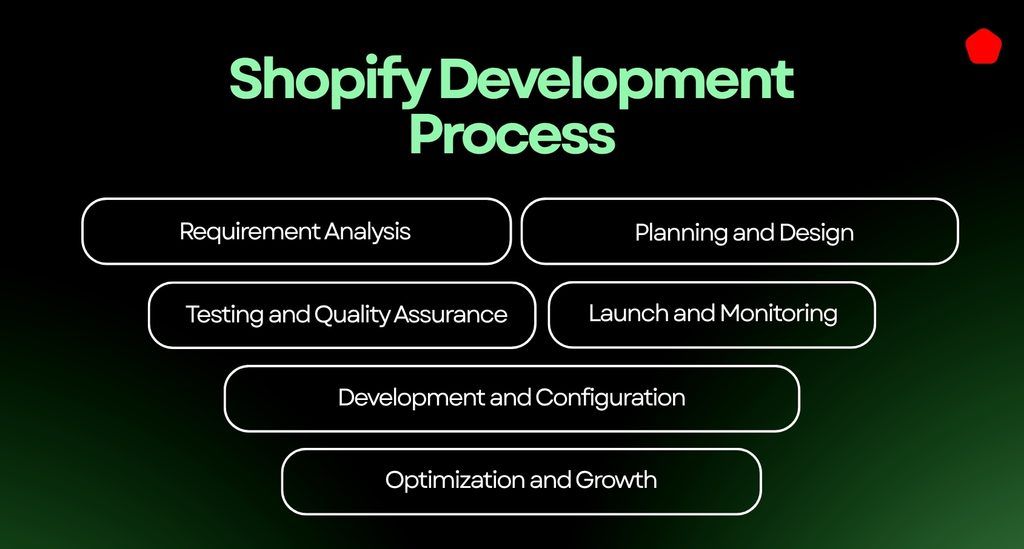
A clear development process helps businesses understand how their requirements become a functioning online store.
Step 1: Requirement Analysis
The project begins with identifying business goals, target customers, product categories, expected order volumes, and essential functionality.
Businesses should prepare a list of must-have features and optional improvements to keep the initial scope manageable.
Step 2: Planning and Design
The team determines the site structure, page layouts, navigation, visual direction, and user journeys. Wireframes or design mockups may be created before implementation, depending on the project.
This stage helps identify usability problems before they become more expensive to fix.
Step 3: Development and Configuration
The development team builds the storefront, configures Shopify settings, adds products and collections, and implements agreed functionality.
Integrations and custom features are developed according to the approved requirements.
Step 4: Testing and Quality Assurance
Before launch, the website should be tested across different devices and browsers. Important checks include product variants, cart functionality, checkout, payment configuration, shipping rules, forms, navigation, and transactional emails.
Businesses should also verify page titles, indexability settings, redirects where applicable, and analytics tracking.
Step 5: Launch and Monitoring
After final approval, the website is connected to its production domain and made available to customers. The team should monitor for broken links, checkout issues, tracking errors, and other problems that may emerge after launch.
Step 6: Optimization and Growth
Following launch, businesses can use analytics, customer feedback, and sales data to identify areas for improvement.
Potential improvements include simplifying navigation, refining product descriptions, improving collection pages, testing calls to action, and addressing checkout friction.
How to Choose the Best Shopify Development Company ?

Selecting a development partner requires more than comparing quotations. Businesses should evaluate technical capability, communication, project transparency, and the provider’s understanding of ecommerce operations.
Review Relevant Portfolio Projects
Examine previous projects for design quality, mobile usability, navigation, product presentation, and functionality. Where possible, explore live stores rather than relying exclusively on screenshots.
Look for experience relevant to your business model, catalogue size, and integration requirements.
Check Technical Expertise
Ask about Shopify theme development, Liquid, HTML, CSS, JavaScript, APIs, third-party integrations, and performance optimization where relevant to your project.
Not every store requires advanced custom development, so the provider should explain which technologies are necessary for the requested scope.
Understand Pricing and Deliverables
Request a written proposal describing the number and type of pages, included features, integrations, testing, migration work, and post-launch support.
Clarify exclusions, revision limits, payment milestones, and how changes to the agreed scope will be priced.
Evaluate Communication and Ownership
A reliable project process includes clear timelines, regular updates, documented approvals, and access to relevant accounts and assets.
Confirm that your business retains appropriate ownership and administrative access to its Shopify store, domain, content, and related accounts.
Ask About SEO and Post-Launch Support
The provider should understand how website structure, mobile usability, redirects, metadata, and performance relate to organic search.
Discuss who will handle technical issues and future changes after launch, along with the associated costs.
Businesses comparing a specialist team with an ecommerce website development company should evaluate the actual Shopify experience, deliverables, and support offered rather than relying only on the provider’s title.
Questions to Ask Before Hiring Shopify Developers
Before signing a contract, ask the following questions:
- What exactly is included in the quoted development cost?
- Will the store use a standard theme, a customized theme, or a custom-built solution?
- Which integrations and paid applications are required?
- Who is responsible for product uploads, content, images, and SEO setup?
- How will existing URLs and search visibility be handled during migration?
- What is the expected timeline, and what could delay the project?
- Who owns the store, domain, code, and related accounts?
- What testing and training are included before handover?
- Is post-launch support included, and what does it cost?
- How will future changes and additional features be estimated?
Comparing providers using the same questions makes proposals easier to evaluate and reduces the likelihood of unexpected expenses.
Common Mistakes to Avoid When Hiring a Shopify Development Company
One common mistake is choosing a provider based solely on the lowest price. A low initial quotation may exclude integrations, content work, testing, or support that the business later needs.
Another mistake is adding too many applications without reviewing their costs and performance impact. Businesses should select tools based on clear requirements and remove unnecessary dependencies.
It is also important not to treat website launch as the end of the project. Product information, technical SEO, analytics, customer experience, and performance require ongoing attention.
Finally, avoid approving a project without clearly documented deliverables, payment terms, revision limits, and account ownership arrangements.
Is Shopify the Right Platform for Your Business?
Shopify can be suitable for businesses that want hosted ecommerce infrastructure, product management tools, payment and checkout capabilities, and access to an application ecosystem.
However, the best platform depends on the business’s technical requirements, budget, operating model, and future plans. Businesses with highly specialized workflows or extensive existing system dependencies should assess integration requirements before committing.
For companies planning a Shopify project, reviewing the available options and consulting experienced shopify experts can help clarify the appropriate scope, implementation approach, and likely investment.
Final Thoughts
Hiring a Shopify development company involves evaluating services, costs, technical expertise, project management, and long-term support. The right approach begins with clear business requirements and a realistic understanding of the features needed at launch.
By comparing detailed proposals, reviewing relevant projects, accounting for recurring expenses, and planning for post-launch optimization, businesses can make more informed decisions about their ecommerce investment.
Dezvolta is one of the providers businesses may evaluate when researching Shopify development services. As with any provider, the decision should be based on relevant experience, transparent deliverables, technical fit, and the ability to support the store’s long-term objectives.
Ready to discuss your Shopify project? Book a free consultation with Dezvolta and get a clear scope, timeline, and cost estimate.
Frequently Asked Questions
Costs depend on scope, design complexity, catalogue size, integrations and migration needs. As a planning estimate, a basic store setup may start around ₹25,000, a customized theme-based store may range from ₹60,000 to ₹1,50,000, and advanced custom builds can go higher. Always ask for a written quotation that separates one-time development charges from recurring costs such as the Shopify plan, paid apps and domain.
It depends on the scope. A simple theme-based store can often be launched faster than a customized storefront with integrations or a migration from another platform. Content readiness, product data, approvals and testing also affect the timeline. Ask your provider for a milestone-based schedule and a list of what could cause delays.
A standard theme suits businesses that want to launch quickly with a limited budget. A customized theme works well when you need stronger branding and better product page layouts. A fully custom build makes sense only when your workflows or features can’t be achieved through themes and apps. Start with launch-critical features and add enhancements later.
Confirm what the quotation includes, which paid apps and integrations are needed, who handles product uploads, content and SEO setup, and how many revisions are included. Also ask about payment milestones, testing and training before handover, and the cost of post-launch support. Make sure your business keeps ownership and administrative access to the store, domain and related accounts.
Many providers include technical SEO work such as page structure, metadata, redirects during migration, structured data and performance optimization. Technical setup gives your store a foundation, but it doesn’t guarantee rankings, because results also depend on content, competition and ongoing optimization. Ask whether ongoing maintenance, bug fixes and future development are included or billed separately.